Normalizing 20,000 Components: The Data Pipeline Behind SMT Assembly Intelligence
A 10kΩ resistor has at least eight names in the wild. Here is how a regex-driven normalization engine turns manufacturing chaos into a canonical data layer.
- Published
- March 9, 2026
- Author
- Hrushiekesh Reddy Kanjula
- Read time
- ~7 min
- Category
- engineering
If you ask five different customers for a 10kΩ resistor and they all send you a BOM, you will get five different strings: "10k Res", "Resistor 10 kilohm", "RES 10K 1%", "10000 Ohm SMD 0402", "R 10K/0.1". These all describe the same physical component. A machine needs to place exactly one of them. The software that bridges that gap — parsing, categorizing, normalizing, and canonicalizing these strings at scale — is one of the most underappreciated engineering challenges in electronics manufacturing.
The assembly hub manages a component library of over 20,000 unique entries. Here is how the normalization engine works.
The 18 Component Family Taxonomy
Before you can normalize anything, you need a taxonomy. The first architectural decision was partitioning all components into 18 distinct family profiles — resistors, capacitors, inductors, diodes, MOSFETs, BJTs, ICs, connectors, crystals, and so on. Each family has a specific set of attributes that matter for assembly: a resistor needs Value, Tolerance, Wattage, and Package; a capacitor needs Value, Voltage Rating, Dielectric Type, and Package; a connector needs Pin Count, Pitch, and Gender.
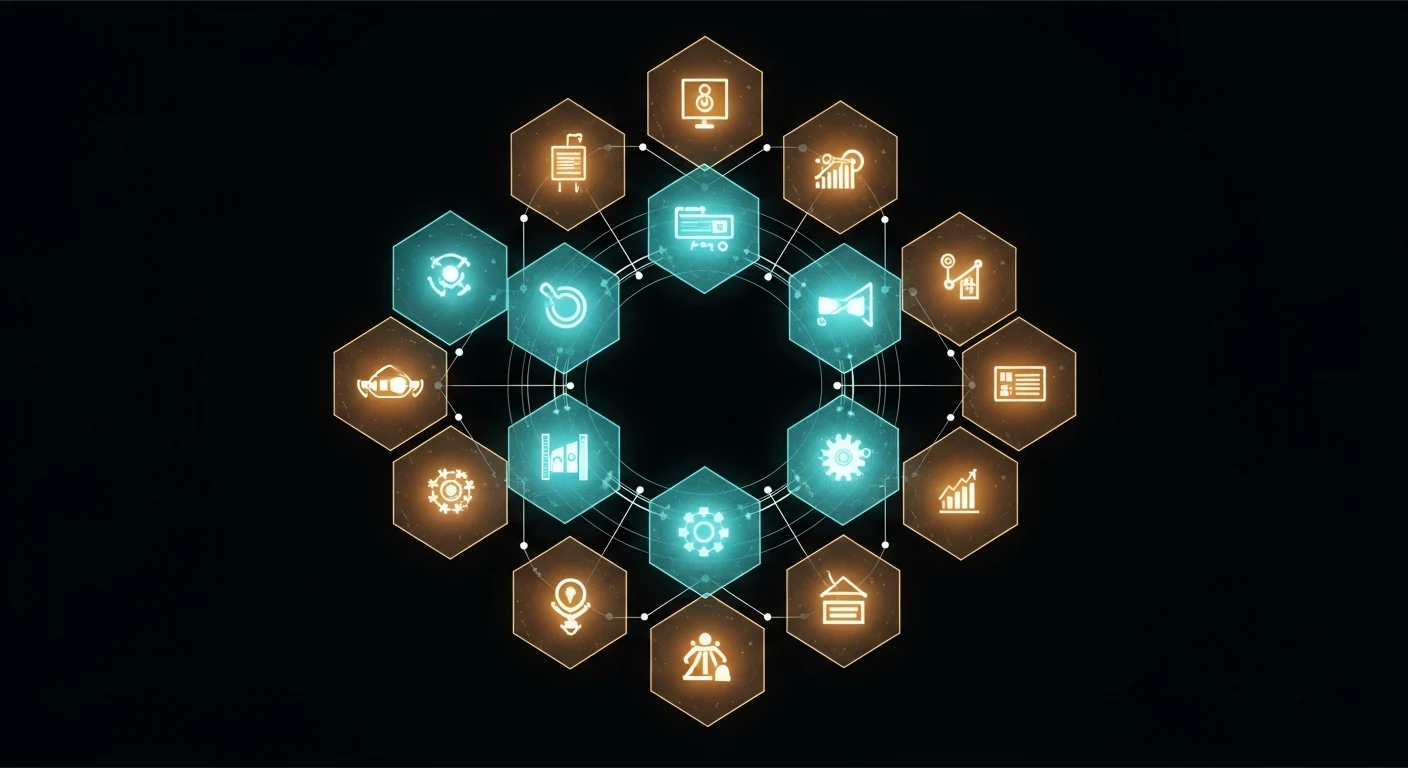
This taxonomy drives everything downstream. When the normalization engine encounters an input string, its first job is family classification — and it does this with regex patterns that match known family indicators before attempting attribute extraction.
The 7-Token Canonical Format
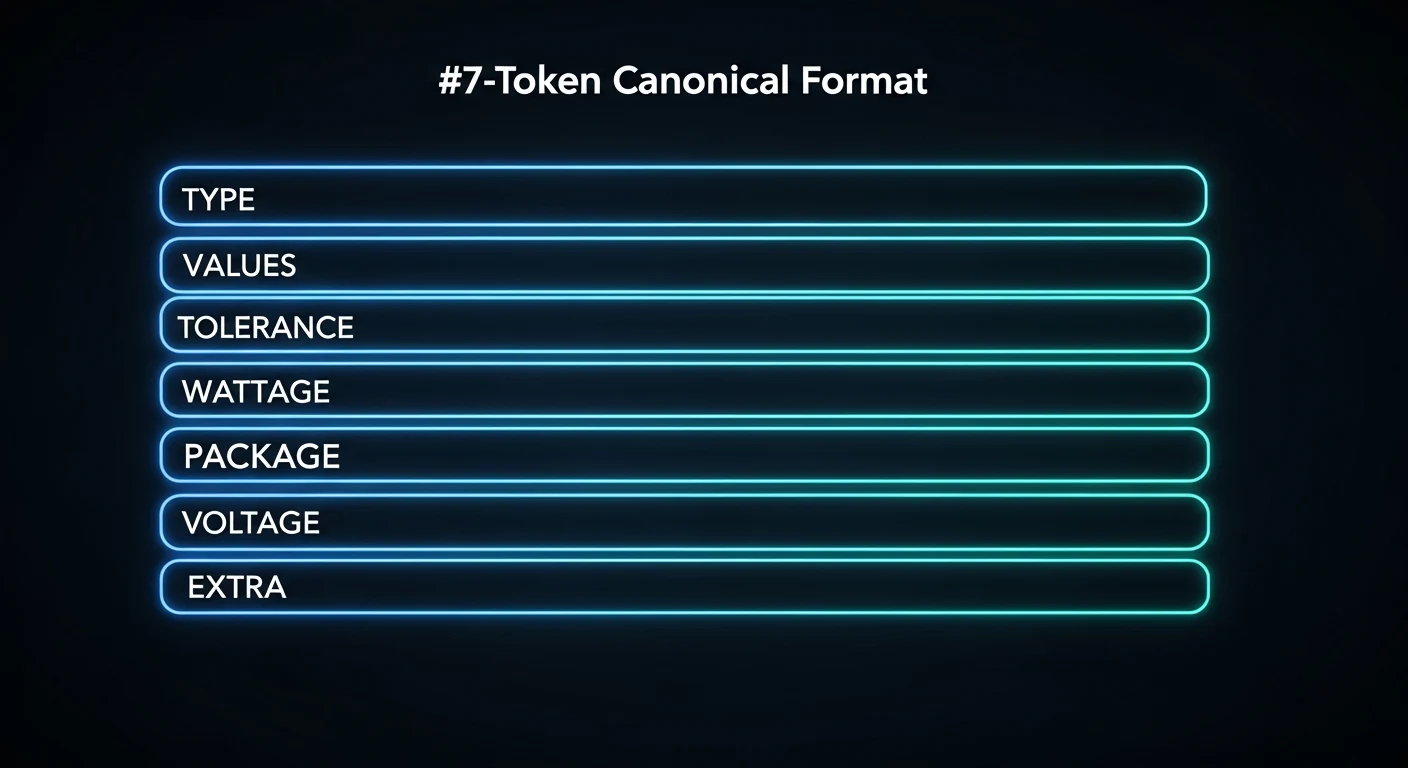
Every component, regardless of family, normalizes to the same 7-token output format:
Type | Value | Tolerance | Wattage | Package | Voltage | Extra
Tokens that don't apply to a given family are set to standardized null markers, not empty strings. The uniformity is the point: downstream queries, joins, and reports all work against the same schema regardless of what family they're querying.
For a 10kΩ 1% 0.1W 0402 resistor, the canonical output is:
RES | 10K | 1% | 0.1W | 0402 | - | -
For a 100nF 10V X7R 0402 capacitor:
CAP | 100N | 10% | - | 0402 | 10V | X7R
The consistency means a line of production reporting code never needs to know what family it's dealing with — it always reads token[4] to get the package size.
The Normalization Pipeline
Input strings go through four sequential transformation stages:
Stage 1 — Unit Standardization. Raw values arrive in inconsistent formats: 10k, 10K, 10 kilohm, 10000, 0.01M. A unit normalization layer converts all resistance values to a canonical SI-prefix form (10K), all capacitance values to picofarads for comparison, and all voltage values to the same scale. This is where idempotency failures hide — a naive implementation of 10K → 10KOHM applied twice produces 10KOHMOHM. Every substitution rule is written with a regex that matches the un-normalized form only, ensuring multiple pipeline passes are safe.
Stage 2 — Family Classification. After unit normalization, the string is matched against family-specific regex batteries. Resistor indicators (RES, RESISTOR, Ω, OHM) trigger the resistor extraction pipeline. Capacitor indicators trigger a different pipeline. Unknown strings fall through to a fuzzy classification layer.
Stage 3 — Attribute Extraction. Within a classified family, individual attributes are extracted using targeted regex patterns. Value, package, tolerance, and wattage each have dedicated extractors with fallback patterns for unusual formats.
Stage 4 — Mouser API Enrichment. For components that survive extraction but have incomplete attributes (common for custom or specialty parts), the pipeline queries the Mouser Electronics API to fill gaps using the manufacturer part number as a lookup key. This adds real-time market data — pricing, availability, lead times — alongside the normalized attributes.
The Idempotency Problem in Detail
The most insidious bugs in a normalization engine are idempotency failures — transformations that produce incorrect output when applied more than once to the same string. In production, BOMs get re-imported. Components get re-normalized when the library updates. If your pipeline isn't idempotent, the second run corrupts data that the first run correctly normalized.
A real example from the build: a suffix-appending rule converted "OHM" to "OHMS" for consistent plural form. Applied to "10K OHM", it correctly produced "10K OHMS". Applied a second time, it produced "10K OHMSOHMS". The fix was to rewrite the rule as a regex that only matches strings that don't already end in "OHMS":
# Broken — not idempotent
value = value.replace("OHM", "OHMS")

# Fixed — idempotent
import re
value = re.sub(r'OHM(?!S)', 'OHMS', value)
Every substitution rule in the engine follows this pattern. The test suite includes an idempotency test that runs every input through the pipeline twice and asserts identical output.
Handling the Long Tail
With 20,000 components across 18 families, the normalization engine handles the 90% case well. The long tail — legacy parts, custom assemblies, non-standard nomenclature from specific manufacturers — requires a different approach.
The engine flags components it cannot confidently classify with a confidence score. Flagged components surface in a UI review queue where engineers manually confirm or correct the classification. Those corrections feed back into the normalization rules, extending coverage over time. The system learns from exceptions rather than requiring upfront enumeration of every possible input format.

Why This Infrastructure Investment Pays Off
The normalization engine is unglamorous infrastructure. It took weeks to build, and users don't see it — they see a clean component library and accurate production reports. But every feature downstream depends on it. Cross-referencing AOI defect data against component specs requires normalized part numbers. Predicting hardware degradation requires normalized package sizes. Generating machine-ready CPL files requires normalized rotation data.
Bad data at the foundation corrupts every query that touches it. The 20,000-component canonical library is the foundation the entire assembly hub stands on.