The Agentic Trio: Using Claude Code, Cursor, and Google Antigravity Together
I spent months running Claude Code, Cursor, and Google Antigravity 2.0 side-by-side on real projects. Here's what the combined agentic stack actually looks like — and where it breaks.
- Published
- January 26, 2026
- Author
- Hrushiekesh Kanjula Reddy
- Read time
- ~7 min
- Category
- essay
Over the past six months I've been wrestling with a question that keeps coming up in every engineering conversation I have: should I pick one AI coding tool and go deep, or layer several together? After running real projects through Claude Code, Cursor, and Google's freshly-launched Antigravity 2.0, I have an answer — and it's more nuanced than the YouTube thumbnails would have you believe.
The Three Tools, Briefly
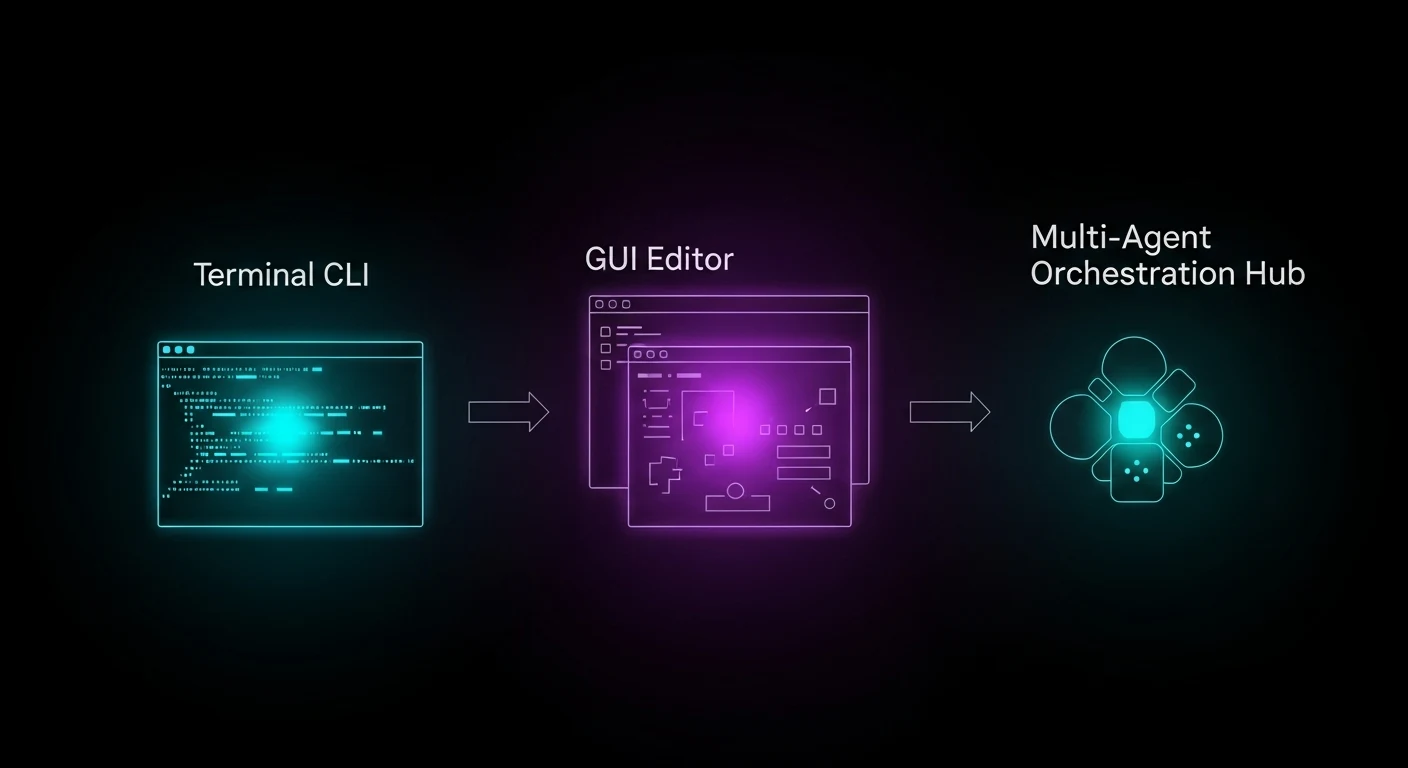
Claude Code is Anthropic's terminal-first agent. You run it from the command line alongside whatever editor you already use. It thinks deeply, holds up to a million tokens of context (Opus 4.7), and excels at complex reasoning over large codebases — cross-file refactors, debugging chains, and architectural decisions. It is deliberately headless: you compose it into scripts and pipelines.
Cursor is a VS Code fork that bakes AI into the GUI. Tab completions, visual diffs, inline chat, codebase indexing — it's the "just works" daily driver for most engineers making the switch from vanilla VS Code. Speed and polish define the experience, and its Tab key has probably saved me more time than any other single feature in 2026.
Google Antigravity 2.0, announced at I/O 2026 on May 19, is something different entirely. It's not really an IDE so much as a team of agents. You describe a goal and Antigravity spins up dynamic subagents that plan the architecture, write code, test it in a live browser, fix errors, and loop — all in parallel. It ships a desktop app, a CLI, an SDK, and a managed agent service in a single product. Gemini 3.5 Flash powers it at around 289 output tokens per second, which means it moves.
How They Work Together — The Agentic Stack
The mental model I settled on is this: Claude Code is your senior architect, Cursor is your daily coding environment, and Antigravity is your autonomous sprint team.
In practice a typical feature cycle looks like this:
- Kick off with Antigravity — give it the feature spec. Its multi-agent orchestration scaffolds the implementation, spins up a browser to validate the UI, and hands back a working prototype in minutes. You're not typing; you're directing.
- Refine with Cursor — pull the generated code into your editor. Cursor's codebase index makes navigating and tweaking the scaffold fast. Tab completions fill in the details; inline diffs make reviewing safe. This is where you actually read the code and make it yours.
- Deep-dive with Claude Code — when something is genuinely hard (data model design, a performance regression, a multi-file refactor with subtle dependencies), drop into the terminal and let Claude Code reason through it with full context. Its 1M-token window means it can hold the entire project in mind at once.
The flow isn't always linear. Some days I open Claude Code first to think through an architecture before touching Antigravity. Other days I never leave Cursor. The point is that each tool has a lane, and knowing which lane to drive in is the actual skill.
The Advantages
Specialization by design. Each tool does what it was built for. You're not forcing a GUI tool to do deep multi-file reasoning, or asking a terminal agent to click around a browser and verify visual layouts. The result is that each tool performs near its ceiling instead of all three converging on mediocrity.
True parallel velocity. While Antigravity's background agents are running a test suite or scaffolding a new module, you're in Cursor writing something else entirely. This is real parallelism, not the kind where you're just waiting for a loading spinner to finish.
Model selection at the task level. Claude Code defaults to Opus 4.7 for complex reasoning and Sonnet 4.6 for speed. Antigravity runs Gemini 3.5 Flash. Cursor can be pointed at any provider. You're always using the best model for the job, not the one your single-tool vendor decided to support.
Workflow resilience. If Antigravity hits a rate limit, you keep coding in Cursor. If Claude Code's API is slow, Antigravity's agents can cover. A three-tool stack has three failure modes, but also three redundancies.
Compounding judgment. Because the tools are distinct, you develop a sharper intuition for what kind of problem this is — is it a reasoning problem (Claude Code), a speed-and-polish problem (Cursor), or a parallelization problem (Antigravity)? That judgment, over time, is worth more than any individual feature any of the tools ship.
The Trade-offs and Disadvantages
Cost stacks fast. You're paying for three separate services simultaneously. Claude Code's Max plan, Cursor Pro, and Antigravity's Pro tier (or the $100/month AI Ultra for higher limits) easily exceed $150/month before a single API call. For solo developers or early-stage projects, that number deserves real scrutiny against the velocity gain.
Context fragmentation is the silent killer. The three tools don't share memory. Claude Code doesn't know what Antigravity scaffolded last night; Cursor doesn't know what Claude Code reasoned through this morning. You become the context bridge — manually summarizing across tools, pasting snippets, re-explaining decisions. This friction compounds badly on large teams where multiple engineers are using different tools on the same codebase.
Cognitive overhead is real. Three UX paradigms, three token-counting models, three rate limit behaviors, three sets of keyboard shortcuts. Onboarding a new team member to this stack takes time and deliberate documentation. There is no single pane of glass.
Over-engineering risk. For a simple CRUD feature or a one-file script, running three agents is overkill. The specific risk with Antigravity is that it generates opinionated abstraction layers that Claude Code then needs to parse and that Cursor's completions may reinforce without questioning. Sometimes vim and focus are the right answer.
Vendor exposure across three companies. If Anthropic changes Claude Code's pricing, you're exposed. If Google pivots Antigravity's roadmap (and they have a track record here), you're exposed. If Cursor gets acquired, you're exposed. Single-tool shops have one bet; this stack has three.
When This Stack Makes Sense
I reach for all three together on large, multi-day feature work that has both backend complexity and significant UI surface — the kind of problem where I need fast prototyping (Antigravity), ergonomic daily editing (Cursor), and occasional deep architectural reasoning (Claude Code). The sweet spot is projects where the cost of a wrong architectural decision is high and the speed of iteration matters.
For quick bug fixes, isolated scripts, or anything I can hold in my head end-to-end, I use one tool and move on. The stack is a multiplier, not a replacement for judgment about what the task actually needs.
Closing Thoughts
The agentic era isn't about replacing yourself with a single AI product. It's about assembling a workflow where every tool operates in its zone of genius. Claude Code, Cursor, and Antigravity aren't competitors in my stack — they're teammates with different specializations, and the compound effect of using all three deliberately is genuinely different from using any one of them alone.
The friction is real. The cost is real. But so is the velocity when you get the routing right.
If you're building something ambitious, I'd encourage you to spend a week running them together and observing where you naturally reach for each one. That's where the real insight lives — not in the benchmarks or the YouTube comparisons, but in the moment-to-moment decisions of an actual project.
Want to see the projects this workflow produced? The Assembly Hub is linked in my portfolio — take a look and let me know what you think.